
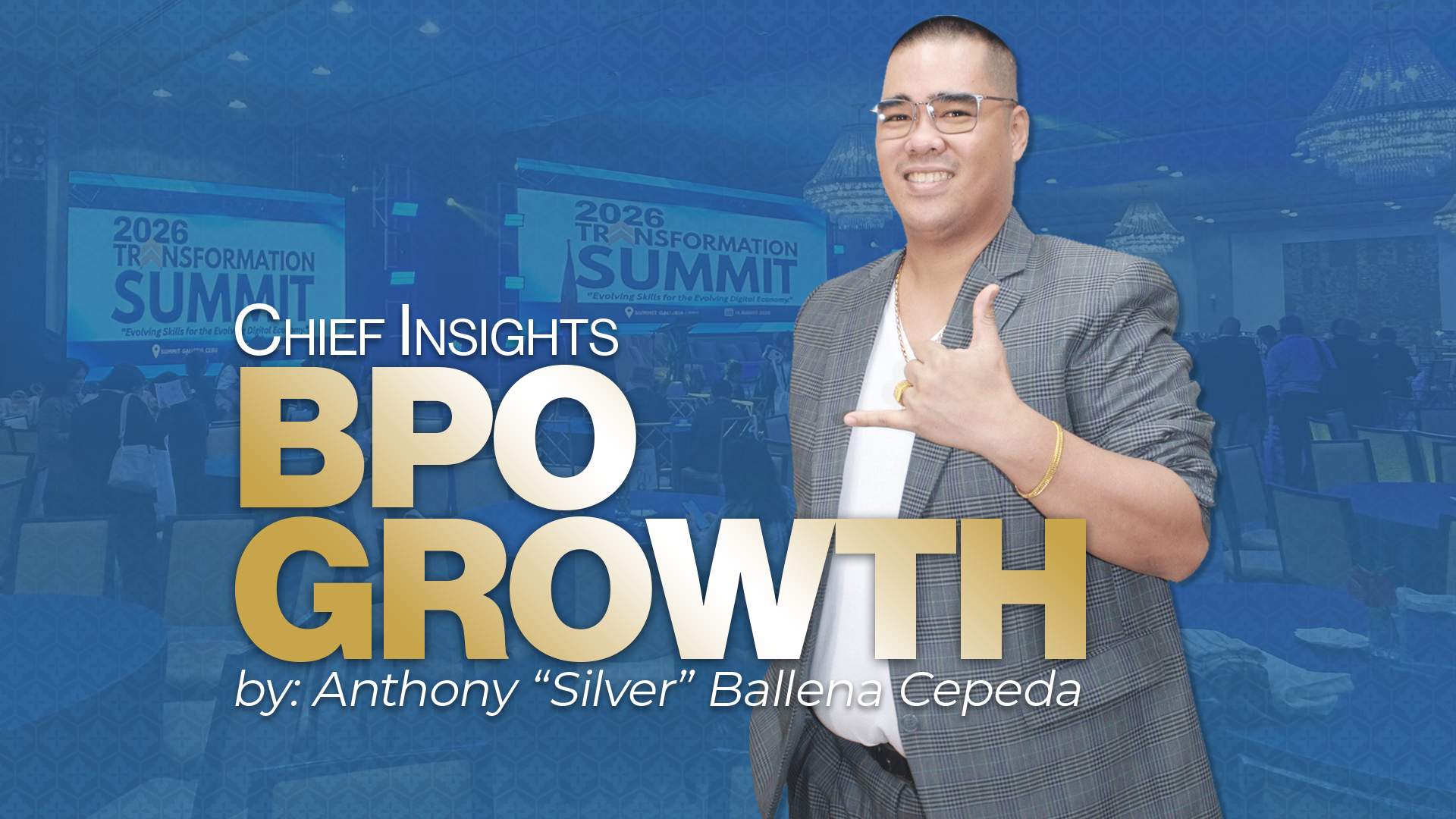
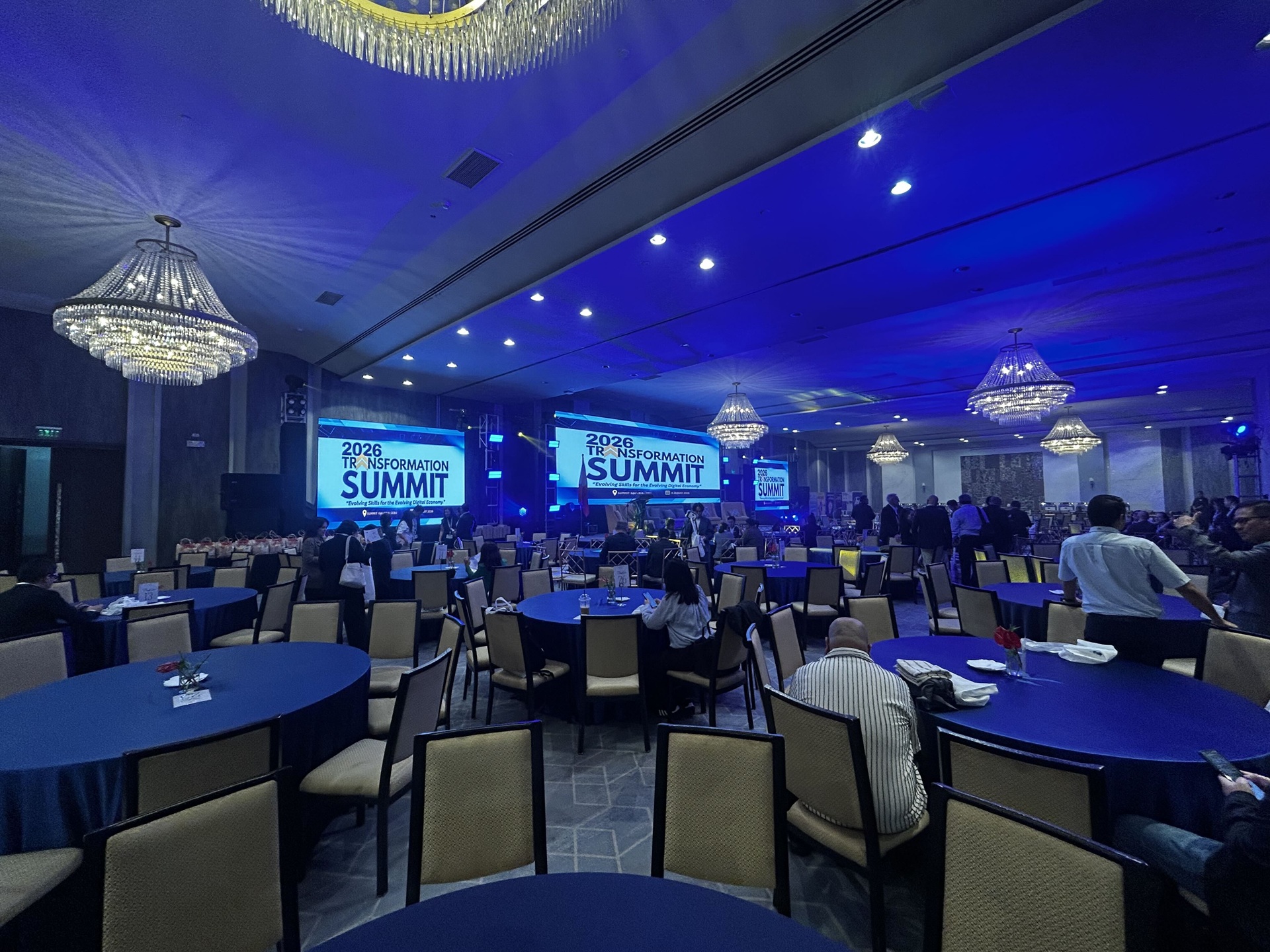
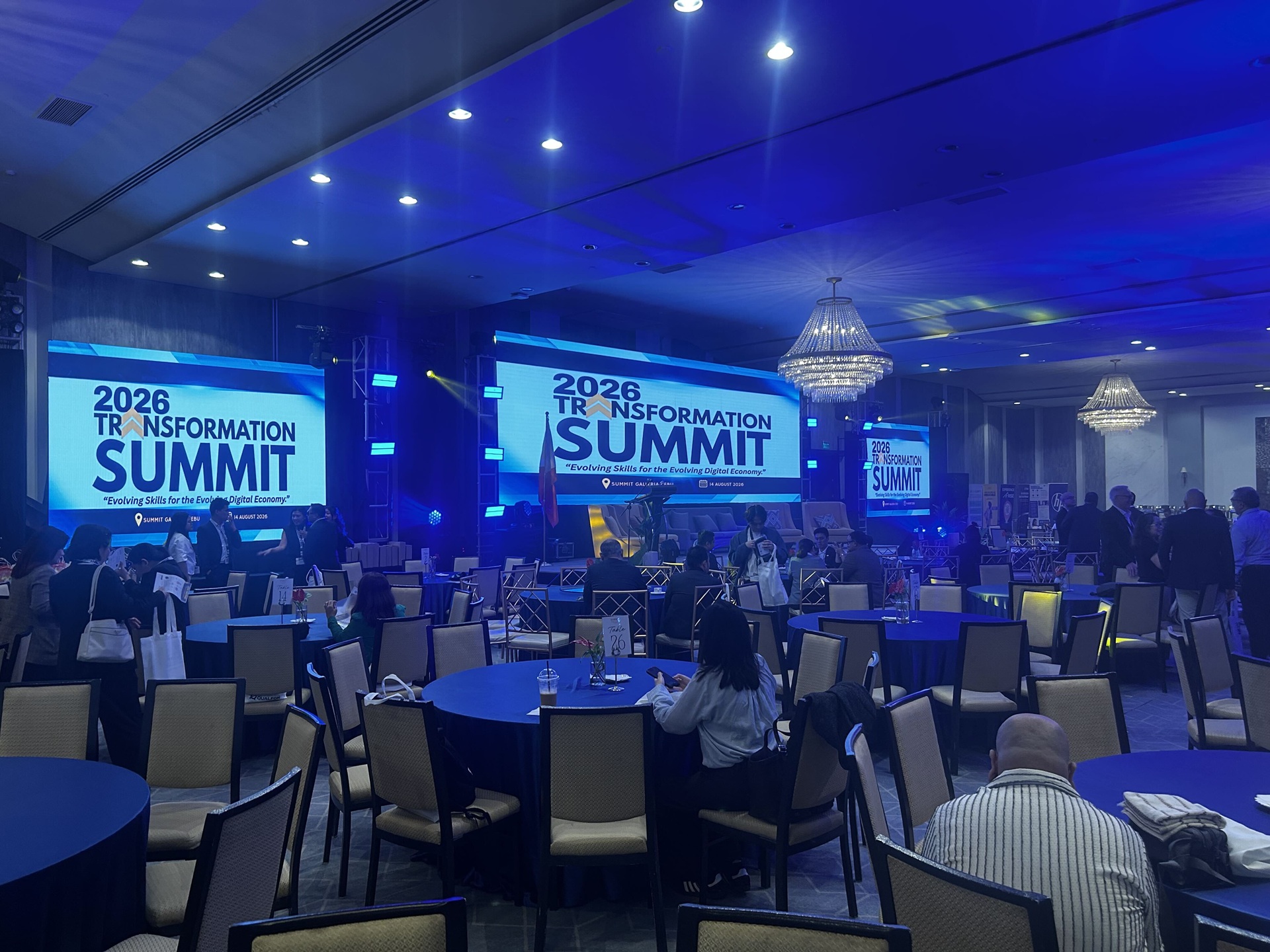
I attended the 2026 Transformation Summit, organized by CIB.O and held at Summit Galleria Cebu, expecting the usual conversations around artificial intelligence, digital transformation, talent, and where the BPO industry is heading. I came home thinking about two numbers.
"6.1% and 3.8%. During his presentation on the state of the Philippine IT-BPM industry, Jack Madrid, President and CEO of IBPAP, showed that revenue growth was running at 6.1%, while employment growth was at 3.8%. At first, both numbers sounded like good news. Then I started thinking about the distance between them."
— Anthony "Silver" Ballena Cepeda, CSO, CTNPFor most of my career, growth was easy to recognize. A 20-seat account became 50. Fifty became 100. One floor became two. One site became several. Hiring meant growth. More FTEs meant growth. More seats meant growth. But as I looked at that slide, I found myself asking a question I probably would not have asked ten years ago: will headcount still be the best measure of BPO growth five or ten years from now? I don't think it will.
Two numbers that stuck with me
The Philippine IT-BPM industry remains strong. IBPAP showed 2025 revenue of approximately US$40.3 billion supported by 1.89 million FTEs, with 2026 estimates reaching US$42.3 billion and 1.94 million FTEs. The Philippines also continued to outperform global industry growth. Those are impressive numbers. But the more interesting story, at least for me, is what's happening underneath them.
We may be seeing the beginning of a decoupling between revenue growth and headcount growth. I use the word beginning deliberately — one year of numbers does not prove a permanent structural change. Revenue can move faster than headcount for many reasons: pricing, service mix, productivity, exchange rates, higher-value work, automation, artificial intelligence, or a shift toward more specialized services. But when those numbers are placed beside what else is happening in the industry, the direction becomes difficult to dismiss.
Philippine IT-BPM industry — revenue vs. headcount growth, 2020–2026F
Revenue (bars) is climbing faster than headcount (line) — the decoupling Silver noticed on the summit stage
Source: IBPAP 2026 Industry Overview (Philippine IT-BPM Industry, 2016–2026F).
AI is improving productivity. Buyers are changing how they evaluate providers. Global competition is becoming more intense. Clients increasingly expect providers to bring technology, process improvement, analytics, expertise, and measurable outcomes — not simply labor.
The old equation
More clients → more agents → more revenue.
The emerging equation
Better people + better technology + deeper expertise + higher productivity = more value.
That is not a small adjustment. That is a change in how we think about the economics of outsourcing.
What was missing from the growth slide interested me most
Another part of Jack Madrid's presentation identified four major growth engines for the industry. I kept thinking about what those four categories have in common — and then I thought about what was not on the slide. Cheap labor.
Global Capability Centers
Built on capability, not cost arbitrage.
Healthcare
Requires accuracy, compliance, domain knowledge and empathy.
BFSI
Requires security, governance, precision and trust.
New Markets
Requires cultural adaptability and multilingual capability.
Cost will always matter in outsourcing — we should not pretend otherwise. The Philippines became a global BPO leader partly because we could deliver strong talent at a competitive cost. But cost increasingly gets you into the conversation. Capability determines whether you remain there. That, for me, was one of the most important realizations from the summit. Our stronger proposition has to become: what can Filipino professionals do that creates greater value for the customer?
Cebu is no longer the alternative
Naturally, one particular slide caught my attention. Cebu. IBPAP presented Cebu as one of the Philippines' fastest-growing economies, with approximately 230,000 IT-BPM FTEs in 2025, an estimated 25 to 30 GCCs, and around 12,000 to 18,000 GCC employees.
For years, Cebu was commonly positioned as an alternative outsourcing destination — an alternative to Manila, a secondary city, a place companies could consider after looking somewhere else. I think that language is becoming outdated. We have decades of BPO experience. We have experienced operations leaders, trainers, quality professionals, technical talent and support organizations. We have a deep talent pipeline, an established voice industry, and increasingly diversified non-voice capabilities. And now we are seeing greater GCC activity as well.
Cebu is no longer simply the alternative to somewhere else. Cebu is a global delivery ecosystem in its own right. The opportunity is substantial — but so is the responsibility. We cannot simply wait for the next generation of outsourced jobs to arrive. We have to prepare people for the next generation of outsourced work.
AI is part of the story. It is not the whole story.
It would be easy to turn all of this into another article about AI replacing BPO workers. I don't think that is the most useful conclusion. AI will absolutely change our industry — anyone running a BPO operation who believes otherwise is taking an unnecessary risk. Routine interactions will increasingly be automated. Knowledge retrieval will become faster. Quality monitoring will become more automated. Some tasks that once required people will require fewer people.
But the summit reinforced something else for me. The workforce being envisioned is not simply smaller. It is expected to become more capable. IBPAP's description of the AI-enabled digital Filipino worker combines three things:
Capability 1
AI fluency
Knowing how to use AI intelligently — but AI fluency without industry knowledge is limited on its own.
Capability 2
Domain expertise
Understanding the business, the process, and the customer. Domain expertise without adaptability becomes outdated.
Capability 3
Human skills
Critical thinking, empathy, leadership and collaboration. Technology without judgment can create faster mistakes.
What becomes valuable is the combination. A person who understands the business, understands the process, understands the customer, and knows how to use AI intelligently becomes significantly more valuable than someone who simply follows a script. That is where I believe the real transformation is happening.
Then I had to look at Cebu tele-net
At some point during the summit, the discussion stopped being purely academic for me. I had to ask myself: are we building Cebu tele-net for the BPO industry that existed for the last twenty years — or for the industry that will exist over the next twenty? I cannot claim that the transformation is finished. It isn't. But I believe we are moving in the right direction.
For more than 30 years, tele-net has built its service philosophy around Japanese Omotenashi — anticipating needs, paying attention to detail, and treating service as something deeper than merely completing a transaction. In the Philippines, that naturally connects with Malasakit: ownership, care and concern for the outcome. Those principles remain relevant. What changes is the technology around them.
"At CTNP, our direction is increasingly to use AI to improve the capability of our people rather than treating AI merely as a mechanism for removing people. That moves us away from thinking of ourselves purely as a provider of seats. We are building toward becoming a customer experience operations partner."
— Anthony "Silver" Ballena Cepeda, CSO, CTNPThat means asking different questions. What should be automated? What should remain human? Where can AI make an agent more effective? Where does the customer still need empathy, judgment or reassurance? Where can data help us see a problem before the client does? Not because "AI-enabled" sounds good in a sales presentation — because the economics of our industry are increasingly demanding it.
Perhaps we need another number beside headcount
I have spent years celebrating accounts because they added people, and I still will. Every additional job represents income, opportunity, career development and a family whose situation may improve because somebody was hired. That should never become insignificant. But perhaps we need another number beside FTE growth: value created per FTE.
- Can one employee solve more complex problems than before?
- Can that person manage higher-value interactions?
- Can technology help them serve customers faster without sacrificing quality?
- Can we move employees from repetitive work into healthcare, finance, technical support, customer success, revenue generation, quality, AI governance or relationship management?
- Can 100 people create an outcome that once required 130?
If the answer is yes, the question should not immediately become "what happened to the other 30 jobs?" The more strategic question is: what higher-value work can those 30 people now be prepared to do? That is where workforce transformation becomes real.
One final realization
I walked into the 2026 Transformation Summit thinking transformation would mainly be a conversation about technology. I walked out thinking much more about value. AI is forcing the industry to confront a question we probably should have been asking more aggressively all along: what are clients actually paying us for?
If the answer is simply people working by the hour at a lower cost, then yes, technology is a significant threat. But if the answer is better customer outcomes, better judgment, faster resolution, stronger relationships, operational resilience, domain expertise, and trust — then technology becomes leverage. Everyone will eventually have access to AI. The tools will spread. The platforms will improve. The technology itself will become less differentiating. What will matter is what organizations can actually do with it.
Key takeaways from the 2026 Transformation Summit
Revenue is decoupling from headcount
6.1% revenue growth against 3.8% employment growth signals the beginning of a structural shift in how BPO growth should be measured.
Capability keeps clients — cost just gets you in the room
None of IBPAP's four growth engines — GCCs, Healthcare, BFSI, New Markets — are built on cheap labor. They're built on expertise.
Cebu has graduated from "alternative" to ecosystem
230,000 FTEs, 25–30 GCCs, and a maturing non-voice sector mean Cebu now competes on its own terms, not as Manila's backup.
The AI-enabled worker needs three things, not one
AI fluency, domain expertise, and human skills — critical thinking, empathy, leadership, collaboration — have to combine, not compete.
Value per FTE deserves a seat next to headcount growth
If 100 people can now do what once took 130, the right question isn't what happened to the 30 — it's what higher-value work they're ready for next.
For years, we became very good at building scale. Now we have to become equally good at building capability. The next BPO growth story will not simply be about how many seats we can fill. It will be about how much value we can create from every seat we have.
Explore CTNP Corp
Frequently asked questions
What were the two key numbers from the 2026 Transformation Summit?
Is AI replacing jobs in the Philippine BPO industry?
Why is Cebu described as "no longer the alternative" for BPO?
What is "value created per FTE" and why does it matter?
How is CTNP applying these insights?

Practical perspectives on customer experience, outsourcing, leadership, and the future of business — drawn from 18+ years inside the BPO industry. A CTNP Corp editorial series.
Building for the next twenty years of BPO?
Let's talk about what value per FTE looks like for your operation — and how CTNP pairs Omotenashi service with AI-augmented delivery.
Book a Consultation →📞 +1-844-370-7222 · 📧 solution@tele-net.co.jp · 🌐 ctnp-corp.com