
Outsourcing Cost Calculators and the Reality of Labor Economics: What One Agent in Cebu Actually Costs—and Why Sustainable Outsourcing Now … read more

Outsourcing Didn’t Fail. Our Operating Models Did.
By Anthony “Silver” Cepeda, Chief Sales Officer, Cebu tele-net Philippines
Part 2: Rebuilding the Architecture of Trust
In the first part of this discussion, the argument was intentionally uncomfortable: outsourcing did not fail because of geography, talent, or culture. It failed because the operating models built around it transferred work without transferring responsibility. The result was predictable—erosion of trust, dilution of accountability, and the quiet collapse of partnerships that once promised strategic advantage.
Part 2 must therefore move beyond diagnosis and into reconstruction. If operating models were the problem, what does a corrected model actually look like?
At Cebu tele-net Philippines, this question was not answered in theory. It was answered through experience, often in moments when client confidence was at risk and internal assumptions were challenged. The realization was sobering: good intentions could not compensate for weak architecture. Discipline had to replace convenience. Structure had to replace hope.
Security, confidentiality, and compliance were among the first areas to be re-examined. As outsourcing expanded digital access and operational reach, it also expanded exposure. Cebu tele-net therefore stopped treating security as a compliance obligation and began treating it as an operating environment. PEZA registration, ISO 27001 certification, and adherence to the Data Privacy Act of 2012 were not adopted as credentials for presentation. They were embedded as daily behavioral standards that governed access control, documentation, training, and audit readiness. Clients were no longer asked to trust intentions. They were shown enforced systems.
Loss of control and reduced agility, another frequent outsourcing frustration, required a different shift in thinking. Control was no longer framed as something the client retained and the provider respected. It was reframed as something both parties shared through visibility. Cebu tele-net rebuilt delivery around client-defined workflows, real-time escalation ownership, and scheduling structures that allowed operational flexibility without structural chaos. Agility was preserved not through informality, but through design.
Knowledge gaps, which often weaken customer experience, demanded a deeper transformation. Cebu tele-net rejected the idea that agents could remain effective while operating only on procedures. Training evolved into immersion. In fintech customer support, agents were taught to understand regulatory sensitivity, transaction integrity, and trust preservation. In transportation and logistics, dispatch and reservation teams were immersed in route dependency, operational urgency, and service continuity. In virtual assistant services for small organizations, agents were developed to think as business extensions rather than task executors. Knowledge was no longer treated as optional enrichment. It became a performance requirement.
Cultural and time-zone friction, long accepted as unavoidable in offshore delivery, were treated as design challenges rather than permanent constraints. Cebu tele-net aligned communication rhythm, reporting cadence, and expectation governance to client operational realities. Offshore delivery no longer asked clients to adjust. It adjusted itself. Structure replaced assumption. Clarity replaced tolerance.
Transition failures, often the silent killers of outsourcing relationships, were addressed by transforming transition into a disciplined project rather than a ceremonial handover. Knowledge documentation, validation checkpoints, parallel run periods, and structured feedback ensured that stability was prioritized alongside speed. The objective was not to appear ready. It was to become reliable.
What gradually emerged from these changes was not a new marketing message, but a different operating identity. Cebu tele-net no longer positioned itself as a provider of outsourced labor. It positioned itself as a guardian of operational discipline. Governance became as important as delivery. Accountability became as valuable as output.
This reconstruction was not driven by ambition. It was driven by humility. By the recognition that outsourcing fails not when people are incapable, but when systems are careless. By the understanding that trust cannot be requested; it must be structurally protected.
The Philippines continues to stand as one of the world’s strongest outsourcing destinations, and Cebu remains a leading center for Cebu BPO services, IT outsourcing, Cebu back-office support, Cebu data entry services, and Cebu virtual assistant services. What differentiates the future of outsourcing from its past is not location, but architecture.
Outsourcing today is no longer a labor decision. It is a governance decision.
And governance, when designed with discipline, transforms outsourcing from an operational risk into a strategic extension of leadership.
Outsourcing did not fail.
Our operating models did.
Part 1 confronted that truth.
Part 2 exists to prove that those models can be rebuilt.
Outsourcing Cost Calculators and the Reality of Labor Economics: What One Agent in Cebu Actually Costs—and Why Sustainable Outsourcing Now … read more
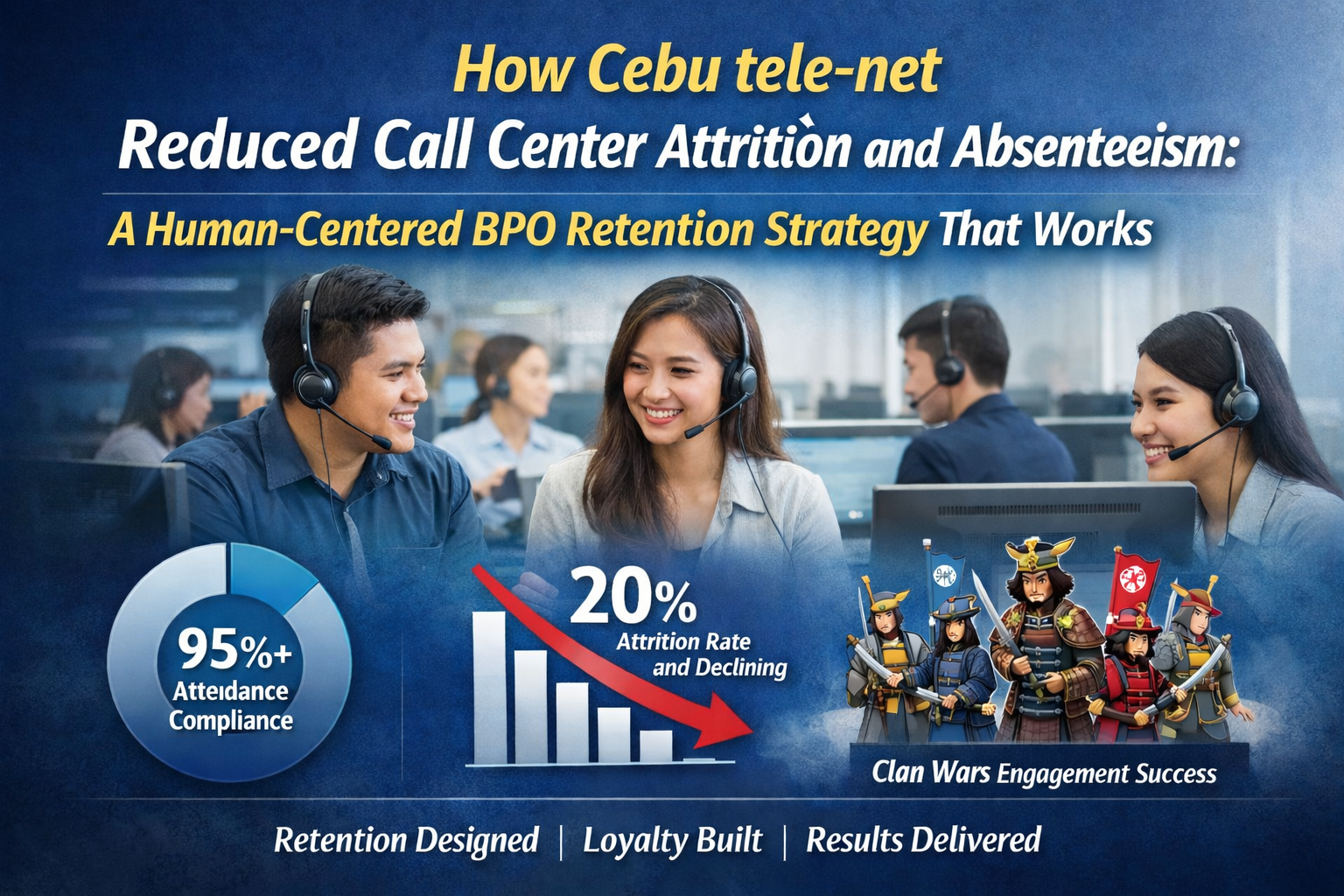
Call center attrition in the Philippines has long been framed as an unavoidable cost of scale. Industry averages ranging from … read more

Why AI-First Customer Service Is Quietly Failing—and Why the Smartest Companies Are Re-Humanizing Support By Anthony “Silver” Ballena Cepeda, Chief … read more