
Outsourcing Cost Calculators and the Reality of Labor Economics: What One Agent in Cebu Actually Costs—and Why Sustainable Outsourcing Now … read more

Outsourcing Didn’t Fail. Our Operating Models Did.
By Anthony “Silver” Cepeda, Chief Sales Officer, Cebu tele-net Philippines
For many years, outsourcing has been framed primarily as a cost-saving strategy. Organizations were encouraged to view it as a financial lever, a mechanism to reduce labor expense while maintaining operational continuity. This narrative was convenient, widely accepted, and rarely challenged. Yet it was also incomplete. Outsourcing did not fail because of geography, culture, or workforce capability. It failed because the operating models built around it were designed to transfer tasks rather than ownership, headcount rather than accountability, and contracts rather than responsibility.
Across the global outsourcing industry, including Philippine outsourcing and Cebu BPO services, the same pattern continues to emerge. Companies enter outsourcing relationships with strong expectations, only to experience gradual erosion of confidence. This erosion rarely begins with dramatic conflict. Instead, it begins quietly, through misunderstood requirements, delayed feedback, unclear escalation paths, and an absence of decision ownership. Over time, these small misalignments accumulate, transforming what was intended to be a strategic partnership into an operational burden.
One of the most persistent illusions in outsourcing is the belief that cost efficiency is primarily a function of labor pricing. Spreadsheets emphasize hourly rates and headcount projections, yet they fail to reflect the operational costs of weak design. Rework, management fatigue, delayed decisions, and quality correction cycles are not visible in early projections, but they are always present in reality. Outsourcing only becomes truly economical when recruitment, training, supervision, quality assurance, and governance are designed as a single integrated delivery system. When these elements are fragmented, cost is not reduced; it is merely redistributed across the organization. This is not efficiency, but accounting theater.
Communication is often discussed as a soft skill within outsourcing, yet in practice it is an operating system. When communication lacks structure, speed, and ownership, alignment becomes dependent on goodwill rather than control. In Cebu outsourcing environments, particularly in customer service outsourcing, back-office support, IT outsourcing, and virtual assistant services, communication must function as a corrective mechanism rather than a courtesy function. Speed of correction is more valuable than elegance of language, because operational alignment is structural rather than emotional.
Quality presents a similar misconception. Industry conversations frequently attribute quality to culture, motivation, or individual commitment. While these factors matter, they cannot sustain consistency at scale. Quality requires architecture. It requires measurement systems, coaching loops, reinforcement cycles, and accountability cadence. Without these elements, quality becomes an aspiration rather than a result. In contrast, when quality is engineered into process, consistency becomes predictable rather than accidental. This distinction defines the difference between outsourcing partnerships that endure and those that quietly dissolve.
Another enduring weakness in outsourcing decision-making is price obsession. Many organizations continue to select outsourcing providers primarily on cost, believing that lower rates represent strategic responsibility. In practice, price rarely measures recovery capability, governance maturity, or operational resilience. The cheapest outsourcing decision often becomes the most expensive operational lesson. Within Philippine BPO services, sustainable partnerships are built not on pricing advantage alone, but on the ability to manage risk, protect data, maintain compliance, and recover quickly from disruption.
Governance, however, remains the most neglected element of outsourcing strategy. Most outsourcing failures are not caused by incompetence, but by ambiguity. When ownership is unclear, escalation paths are undefined, and decision rhythms are absent, accountability disappears. Meetings occur, yet responsibility does not materialize. Outsourcing relationships rarely collapse from disagreement; they collapse from confusion. Strong governance does not restrict partnership. It protects it.
Despite these challenges, the Philippines continues to remain one of the most trusted outsourcing destinations in the world. Cebu, in particular, continues to grow as a center for Cebu BPO services, IT outsourcing, Cebu back-office support, Cebu data entry services, and Cebu virtual assistant services. What has changed is not buyer interest, but buyer expectation. Organizations no longer ask where the call center is located. They ask how risk is controlled, how quality is protected, how governance is enforced, and how failure is prevented. Outsourcing is no longer a labor decision. It is a governance decision.
At Cebu tele-net Philippines, outsourcing is not presented as headcount. It is presented as operating discipline. The organization combines Japanese operational rigor with Filipino service culture, designing delivery models around visibility, correction speed, and accountability. The objective is not to promise perfection, but to provide control. Outsourcing should not reduce ownership; it should multiply it.
The strategic reality is therefore simple. Outsourcing was never meant to replace responsibility. It was meant to extend it. When outsourcing is built on operating architecture rather than marketing promises, it ceases to be an operational gamble and becomes a strategic advantage. Outsourcing did not fail. Our operating models did.
Outsourcing Cost Calculators and the Reality of Labor Economics: What One Agent in Cebu Actually Costs—and Why Sustainable Outsourcing Now … read more
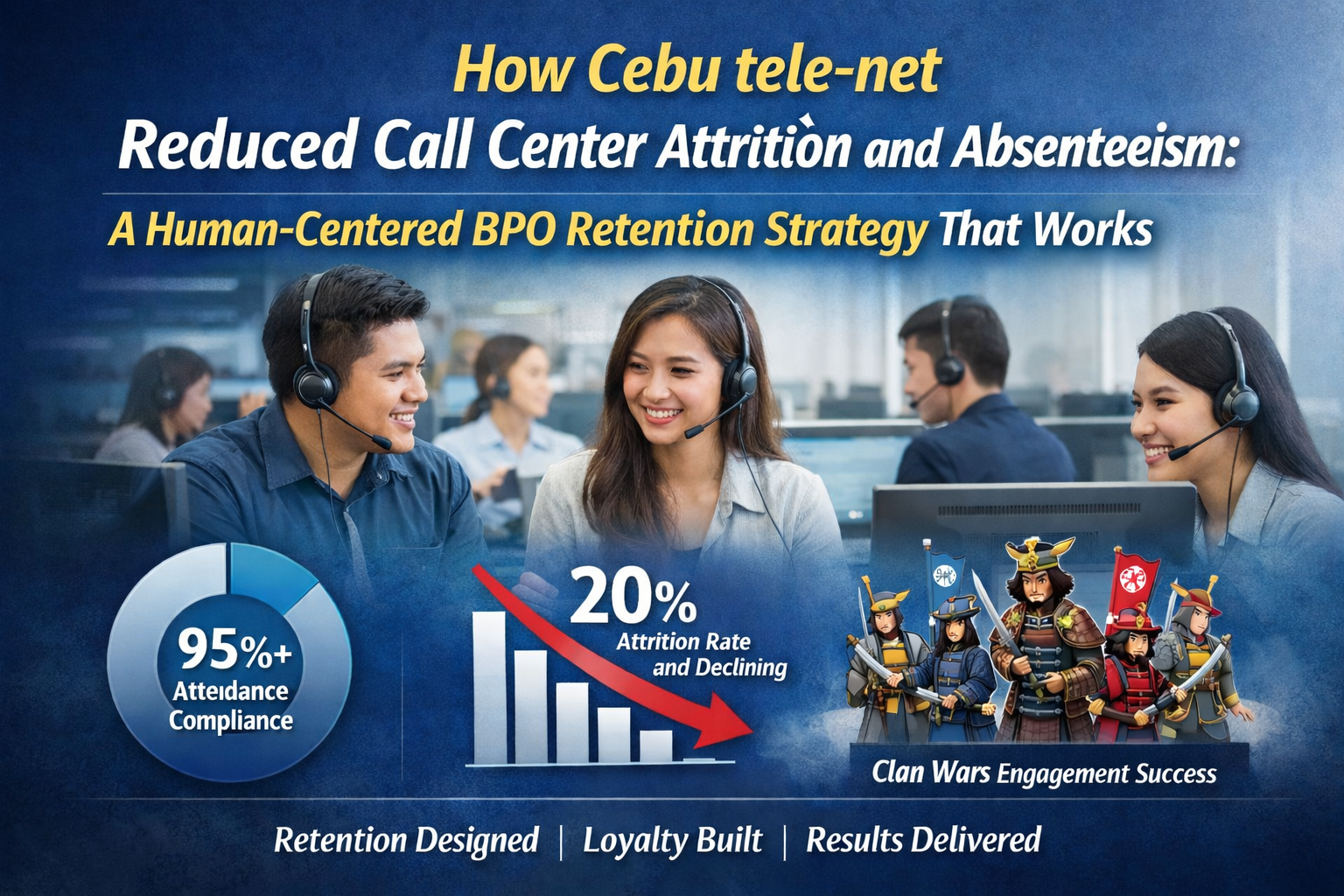
Call center attrition in the Philippines has long been framed as an unavoidable cost of scale. Industry averages ranging from … read more

Why AI-First Customer Service Is Quietly Failing—and Why the Smartest Companies Are Re-Humanizing Support By Anthony “Silver” Ballena Cepeda, Chief … read more